My name is Hasan and I am a beginner composer from Kuwait. I do not know any music theory and I do not know how to read sheet music but I want to get started at learning everything related to music. I have bought a small MIDI keyboard that I use and some music sheet paper.
Do you have any advice for me? I use Anvil Studio and it is a little bit difficult for me due to me not knowing sheet music and I am not sure which program to use to effectively make good MIDIs.
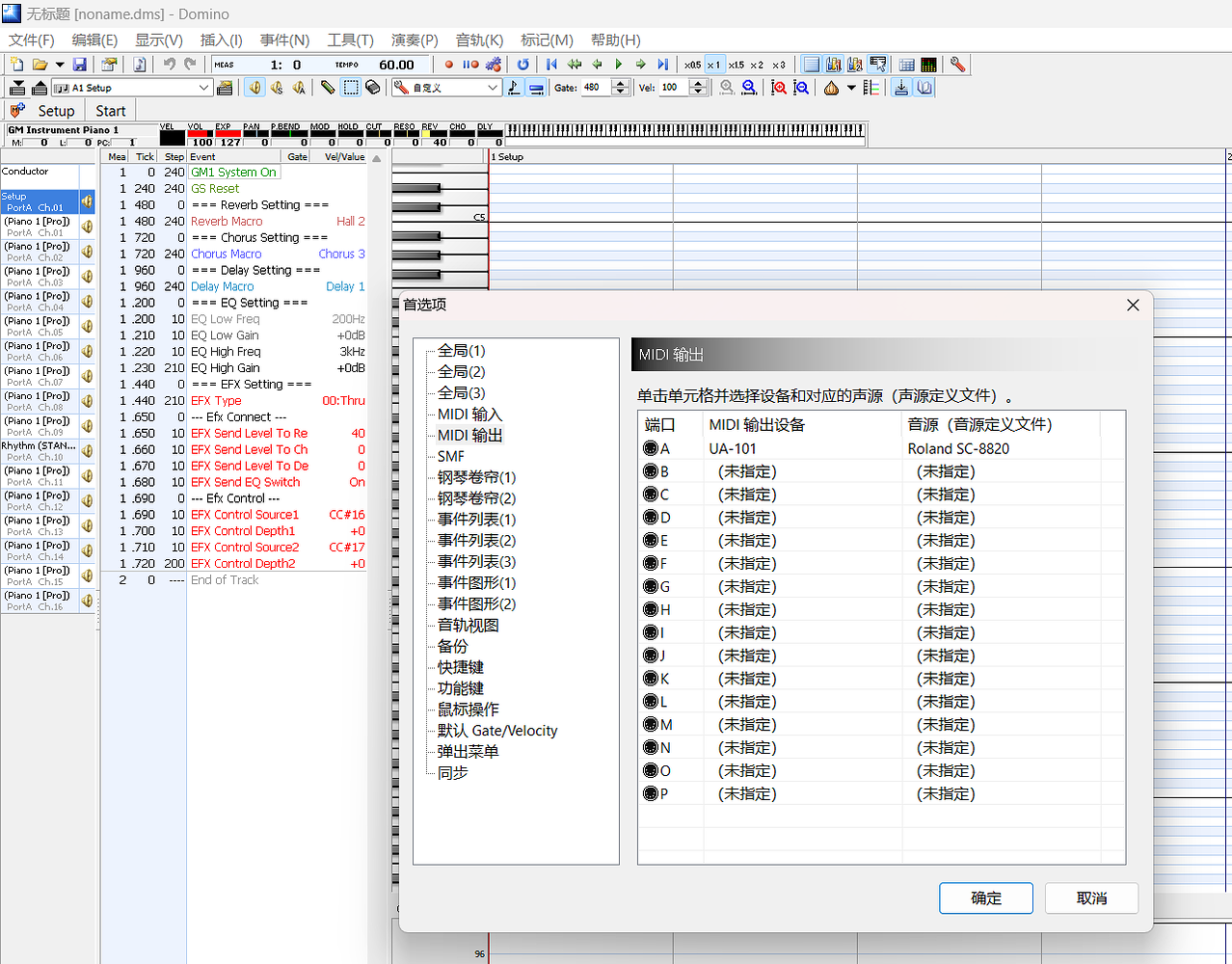
If your only requirement is editing and exporting MIDI, this is the top choice. (Note: It requires port configuration, and exporting audio likely requires playback rendering—direct audio rendering isn’t supported.)
I recommend it because I use it myself. Compared to Anvil (which I’ve used before), Domino is more user-friendly in many ways, especially its concrete and visually clear interface, which I prefer.
Here is the method for configuring the software port settings.
The original software was written for a Shift-JIS system environment, but the community has kindly shared an English patch on GitHub.
Here’s the link—check the README for more details.
More software examples may follow (but don’t get your hopes up).
As mentioned earlier, you’re just starting with music. But do you have any prior experience with music (e.g., singing or listening)
For beginners, we encourage “listening more.”
There’s an old Chinese saying:
If you haven’t seen a real chicken, haven’t you at least eaten fried chicken?
The meaning is: When you’re unsure how to do something, observe how others do it.
This is called “learning by example.”
Everyone has different tastes, which reflects their unique “personality.”
So, in short: “At the beginner stage, listen to songs that interest you.”
After all, if you don’t understand or dislike a piece, your learning progress may suffer.
Thank you for your reply, I hope you do not mind me replying in English as I try to not use AI as often.
I used to play the violin in high school but stopped when I graduated. I do have some prior experience. Our music education here in Kuwait is rather terrible so they only taught me where to put my fingers on the violin to play certain songs.
I never learned any music theory, I wish our education was stronger. I only learned a few scales on my own on the keyboard during that time. C minor and the A minor pentatonic scale.
I will not sugar coat this, Domino looks very intimidating. But, I will give it a try.
@哈桑_侯赛因 I think Anvil is actually quite an old piece of software (Domino is the same).
However, these programs focus specifically on “editing MIDI files themselves.”
More modern DAW music production software could also be said to have MIDI as their foundation.
As for music learning environments, they might not be very well-developed due to broader trends.
Mostly, it’s self-taught. I was genuinely surprised to see that you also play the violin. (You probably read sheet music too, right?)
For people like us, we might never even get the chance to see real instruments in person—computer software is our primary tool.
Without ever touching an actual instrument, there’s no need to even mention whether we can read sheet music. (Even if such people exist, they’re extremely rare.)
First, setting aside software usage, just working with MIDI doesn’t even require music theory knowledge. (After all, it’s just dragging the mouse around.)
To refine a piece of music, you can roughly understand its structure. But the most important thing is to listen more.
At the beginning stage, the first step is to learn how to use the software properly.
By the way, would you mind sharing what music genres you usually listen to?
I can read sheet music but not so good. I cannot sight read but I doubt that is a requirement to become a music composer; I might be wrong.
I listen to all kinds of music, 99% of it is western music. I would listen to rap most often but only for the instrumental/melodies, right now, I have been listening to Timeless by The Weekend a lot. Mike Dean has to be one of my favourite producers out there.
I really like synth-heavy music like for example some video game soundtracks like Portal 2 or Half-Life. That’s what I grew up listening to.
What about you? I am curious to know what kind of music you listen to.
I listen to a wide variety of music, but my main focus is on rock, jazz, and some electronic music from the 90s to the 2000s.
When it comes to video game music, most of what I listen to comes from Japanese game developers (like The Legend of Zelda or Kirby series).
As for Western games, as I mentioned earlier, I have a broad taste and also listen to well-known titles.
When it comes to reading sheet music, I gotta admit hardly anyone around me can actually read it.
Even if you can understand a little bit, that’s pretty impressive already.